Affichage des articles dont le libellé est Livre Arduino. Afficher tous les articles

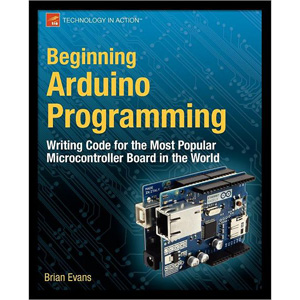
Beginning Arduino Programming


Beginning Arduino Programming allows you to quickly and intuitively develop your programming skills through sketching in code. This clear introduction provides you with an understanding of the basic framework for developing Arduino code, including the structure, syntax, functions, and libraries needed to create future projects. You will also learn how to program your Arduino interface board to sense the physical world, to control light, movement, and sound, and to create objects with interesting behavior.

With Beginning Arduino Programming, you'll get the knowledge you need to
master the fundamental aspects of writing code on the Arduino platform,
even if you have never before written code. It will have you ready to take
the next step: to explore new project ideas, new kinds of hardware, contribute
back to the open source community, and even take on more programming
languages.

What you’ll learn

  • Start programming quickly with Arduino sketches.
  • Write code that interacts with devices, such as LEDs, sensors, and motors.
  • Work with loops, functions, randomness, and delays in your Arduino projects.
  • Develop a style of writing code that reflects your individuality.
  • Use many of the Arduino libraries to control even more devices.
  • Read from RFID readers, write data to SD memory cards, and connect to the Internet using Ethernet.

Who this book is for

This book is for all Arduino board users who want to learn to program the Arduino board, regardless of hardware version or which devices are connected to the board. You do not need to have programmed before, but if you have, then you'll learn how to apply core coding features in the Arduino context.

Table of Contents

  1. Getting Started
  2. Sketching in Code
  3. Working With Variables
  4. Making Decisions
  5. Digital Ins and Outs
  6. Analog in, Analog out
  7. Functions, Time, and Interrupts
  8. Arrays for Arduino
  9. Writing New Functions for Arduino
  10. Arduino Libraries
  11. Arduino Hardware 10
  12. Where to Go from Here?
  13. Appendix A: Common Circuits
  14. Appendix B: Arduino Math

Arduino and Kinect Projects: Design, Build, Blow Their Minds


If you've done some Arduino tinkering and wondered how you could incorporate the Kinect—or the other way around—then this book is for you. The authors of Arduino and Kinect Projects will show you how to create 10 amazing, creative projects, from simple to complex. You'll also find out how to incorporate Processing in your project design—a language very similar to the Arduino language. 

The ten projects are carefully designed to build on your skills at every step. Starting with the Arduino and Kinect equivalent of "Hello, World," the authors will take you through a diverse range of projects that showcase the huge range of possibilities that open up when Kinect and Arduino are combined.
  • Gesture-based Remote Control. Control devices and home appliances with hand gestures.
  • Kinect-networked Puppet. Play with a physical puppet remotely using your whole body.
  • Mood Lamps. Build your own set of responsive, gesture controllable LED lamps.
  • Drawing Robot. Control a drawing robot using a Kinect-based tangible table.
  • Remote-controlled Vehicle. Use your body gestures to control a smart vehicle.
  • Biometric Station. Use the Kinect for biometric recognition and checking Body Mass Indexes.
  • 3D Modeling Interface. Learn how to use the Arduino LilyPad to build a wearable 3D modelling interface.
  • 360o Scanner. Build a turntable scanner and scan any object 360o using only one Kinect.
  • Delta Robot. Build and control your own fast and accurate parallel robot.
What you’ll learn
  • Arduino and Kinect basics
  • Interfacing Kinect and Arduino through Processing
  • Communicating: Serial and communication over networks
  • Interacting with the physical world: Sensors and actuators
  • Volumetric Scanning
  • Step-by-step instructions on a variety of Arduino/Kinect projects
Who this book is for
Intermediate to experienced gadget hackers who want to learn how to combine Arduino with Kinect, or who want inspiration for innovation.
Table of Contents1. Arduino Basics 
2. Kinect Basics 
3. Interfacing Arduino and Kinect through Processing 
4. Hello World: LED-me 
5. Gesture-based Remote Control 
6. Kinect-networked Puppet 
7. Mood Lamps
8. Drawing Robot
9. Remote-controlled Vehicles
10. Biometric Station 
11. 3D Modeling Interface
12. 360o Scanner
13. Delta Robot

Practical Arduino: Cool Projects for Open Source Hardware


Create your own Arduino-based designs, gain in-depth knowledge of the architecture of Arduino, and learn the user-friendly Arduino language all in the context of practical projects that you can build yourself at home. Get hands-on experience using a variety of projects and recipes for everything from home automation to test equipment.
Arduino has taken off as an incredibly popular building block among ubicomp (ubiquitous computing) enthusiasts, robotics hobbyists, and DIY home automation developers. Authors Jonathan Oxerand Hugh Blemings provide detailed instructions for building a wide range of both practical and fun Arduino-related projects, covering areas such as hobbies, automotive, communications, home automation, and instrumentation.
  • Take Arduino beyond "blink" to a wide variety of projects from simple to challenging
  • Hands-on recipes for everything from home automation to interfacing with your car engine management system
  • Explanations of techniques and references to handy resources for ubiquitous computing projects
Supplementary material includes a circuit schematic reference, introductions to a range of electronic engineering principles and general hints & tips. These combine with the projects themselves to make Practical Arduino: Cool Projects for Open Source Hardware an invaluable reference for Arduino users of all levels. You'll learn a wide variety of techniques that can be applied to your own projects.

What you’ll learn

  • Communication with serial devices including RFID readers, temperature sensors, and GPS modules
  • Connecting Arduino to Ethernet and WiFi networks
  • Adding synthesized speech to Arduino
  • Linking Arduino to web services
  • Decoding data streams from commercial wireless devices
  • How to make DIY prototyping shields for only a couple of dollars

Who this book is for

This book is for hobbyists and developers interested in physical computing using a low-cost, easy-to-learn platform.

Table of Contents

  1. Introduction
  2. Appliance Remote Control
  3. Time-Lapse Camera Controller
  4. Virtual USB Keyboard
  5. PS/2 Keyboard or Mouse Input
  6. Security/Automation Sensors
  7. Online Thermometer
  8. Touch Control Panel
  9. Speech Synthesizer
  10. Water Flow Gauge
  11. Oscilloscope/Logic Analyzer
  12. Water Tank Depth Sensor
  13. Weather Station Receiver
  14. RFID Access Control System
  15. Vehicle Telemetry Platform
  16. Resources


Share

Twitter Delicious Facebook Digg Stumbleupon Favorites